Monday, 5 March 2012
Exhibition: Stuart Bird
Exhibition : Cameron Platter
Wednesday, 26 January 2011
Exhibition: Shadow Catchers: Camera-less Photography
Adam Fuss'Invocation'
1991
Shadow Catchers: Camera-less Photography
13 October 2010 – 20 February 2011
Victoria and Albert Museum, London
In the 1830s Britain looked on in astonishment as William Henry Fox Talbot successfully drew with light. Talbot’s camera-less photograms, generated by filtering light through solid form onto photographic paper, were praised for being so accurate in tone that they were mistakenly confused for the original object. Almost a century later this method of image production regained popularity with the abstract photograms of Man Ray and László Moholy-Nagy. Working independently from one another, both of these artists were in search of a modernistic photographic essence. Both Ray and Moholy-Nagy were concerned with distancing the photograph from realistic representations of the outside world and would try to offer new perspectives and experiences by removing the camera and its particular way of seeing. This is still the case with more contemporary camera-less photography. Here camera, lens and film no longer work in unison to produce a type of temporal and spatial depiction of reality. Instead there is a simplification of technique; objects are placed between light source and photosensitive paper and then exposed to light. There is a greater level of control in the selection and composition in this type of photographic documentation, making it more akin to drawing than camera-based photography, and therefore in many ways, more adept at communicating an internal reality. Although a seemingly straightforward theme, camera-less photography is in fact an extremely visually prolific and theoretically complex discipline. Exhibitions focussing on this genre of photography run the risk of being bogged down by the technical science of emulsion, photographic chemicals and exposure. On the other hand, camera-less photography is capable of providing a platform to investigate and breakdown in plain terms the perceived indexicality of pre-digital photography.
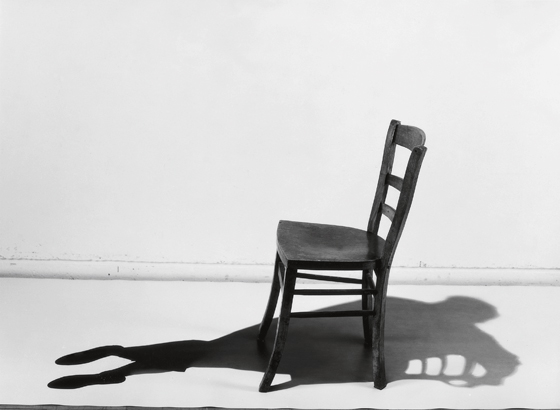
With these thoughts in mind, I entered ‘Shadow Catchers: Camera-less Photography’. The exhibition presents five artists: Floris Neusüss, Pierre Cordier, Garry Fabian Miller, Susan Derges and Adam Fuss. Each artist’s work is confined to a separate room, the first of which showcases German artist and writer, Neusüss’, full body photograms. The three-dimensionality of these naked figures is implied through the subtle gradations of tone and the manner in which the edges of the figure are slightly fuzzy (the further away the subject is to the photographic paper, the less in focus it will be). These works provide the viewer with a straightforward example of large-format camera-less photography and an engaging and scholastic study of the female form. In Neusüss’ photogram installation, Be Right Back (1984 and 1987), a chair has been placed on top of a large piece of photographic paper capturing the shadow of a seated phantom. This is a playful and savvy comment on the temporality of photography in that photographs record a past presence and therefore present their very own version of death. I found Neusüss’ less figurative work most compelling. His Gewitterbild, Kassel, 1984 (1984) was made through exposing light-sensitive paper during a thunderstorm at night. The turbulent atmosphere of a storm is persuasively echoed in the abstract marks on the photographic paper.
The next room is devoted to the innovative artist, Pierre Cordier (b.1933) and his ‘chemigrams’. On entering Cordier’s area, one is struck by the scientifically experimental nature of his works. He achieves this through exploratory play with photographic chemicals and other materials, such as varnish, wax, glue and eggs. The results are varied, in Chemigram 8/2/61 I, 8 Février 1961 (1961), imbrications of tone and fluidity look like abstract molten mountaintops made from pouring fixative and developer onto lightly oiled photographic paper. Others like Chemigram 20/3/92 ‘from La Suma of Jorge Luis Borges’ look more like acutely intricate labyrinth patterns.
Although Miller’s outcomes are presumably less subject to fortuitous experimentation, he, like Cordier, is obsessed with pushing the boundaries of chemical exploration. Focussing on the materiality of photographic paper he experiments with glass containers filled with coloured liquid. Miller’s coloured circles and squares are meant to represent a space one can inhabit. The spaces in between, where hue emerges and disappears, are meant to signify the transitory nature of being. Having seen Miller speak at The Ingleby Gallery in Edinburgh in 2009, I admittedly found his work far more engaging once I had learnt of his painstakingly precise and monomaniacal process. In Breathing in the Beech Wood, Homeland, Dartmoor, Twenty-four Days of Sunlight, May 2004 (2004) he filters light through beech leaves to demonstrate photosynthesis. Moving from left to right of the photograph, these leaves start with an exposure of one day and increase incrementally up to two weeks. Many of his photographs involve long periods of exposure, some for as long as a year.
Likewise, Derges’ photograms also, strive to reveal hidden forces of nature and convey a sense of the transient, both evolving and dissolving. She is perhaps best known for her photograms of water, created by placing photographic paper in a river at night, which she then exposes with a flashlight. In line with her affinity to nature is her series of arches depicting seasonal scenery. These are produced through a complex mixture of technical procedures, from digital scans to direct prints and then finally, re-photographing. These magical landscapes succeed in portraying the emotion and atmospheric impressions attributed to each season.
The final room is dedicated to the British born artist, Fuss. His dye-destruction photogram, Invocation (1992), is made through floating baby in shallow water over photographic paper and then exposing it with a flashlight. Impressions are left relative to the closeness to the photographic paper. This succeeds in giving the baby a three- dimensional presence and an illusion of an inner spiritual essence. This notion of spirituality is further implied through the title, Invocation. Fuss is more concerned with the inside world than portraying the outside, and his work is rich with symbolism and ideas of the metaphysical. His snakes and ladders and ghosts of reality attempt to deconstruct what it means to be alive and sentient. Indeed, Fuss’s photograms of real elements represent the object as floating in his own mind space, as if part of a dream.
Shadow Catchers offers a palatable introduction to an intriguing and technically complex area of photographic production. It is evident that the artists and their photographs were chosen on the basis of offering thematic variety. However, both the selection of artists and their spatial organisation seem somewhat arbitrary. The screening room, showing short informative films, introduce each artist and their particular method of production. These films provide the only point of intersection, but even this seems a superficial denouement, leaving the viewer with a sense of being shown only the tip of the camera-less photography iceberg. Nevertheless, even though its slight, with its mere five artists and their five rooms, this exhibition does succeed in covering a great deal of ground and leaves one with an blanket sense of what is happening in contemporary camera-less photography.
Tuesday, 28 December 2010
Exhibition: Francesca Woodman


Francesca Woodman
17 November 2010- 22 January 2011
Victoria Miro
It is uncommon to encounter so many of Francesca Woodman’s (1958-1981) photographs in one exhibition. This show offers the opportunity to see almost one hundred of her works, including some that have never before been publicly displayed. Woodman is no doubt a fascinating figure, heralded posthumously as a significant female photographer by both feminist critics and curators. Although Woodman has been ideologically positioned amongst the likes of Ana Mendieta, Hannah Wilke and Carolee Schneeman, she is certainly the least conspicuous of the grouping. Her self-exploration through the repeated capturing of her own form, in addition to her suicide at the young age of twenty-two, makes her photography paradoxically alluring.
Certain themes and visual tags recur and coalesce throughout Woodman’s imagery, namely camouflage/invisibility, mirroring/doubling and water/fluidity. Located within these themes is the female form, almost always, in some way, responding to its surroundings. Sometimes this response is a contrast between the softness of the female nude with the harsh coldness of its surroundings. Or, in others, the disappearance of the nude as it visually dissolves into its environment.
Often the face of the naked figure is obscured through hair, movement blur or other means. For example, in Untitled, Providence, Rhode Island (1976) each naked girl is given a head shot of Woodman to hold in front of her face. Alongside one another the naked bodies are indistinguishable. By hiding the faces and in turn the identity of her female subjects, Woodman submits the body as decorative and this helps to emphasise the playful experimentation of her photography.
Viewing so many of Woodman’s photographs under one roof gives the visitor a comprehensive insight into Woodman’s very particular way of seeing. Their surreal quality, although at first seemingly orchestrated, are surprising in their oddness. Her photographs grapple with representation and reality and the sense of displacement that lies tense in the space in between.
Saturday, 11 December 2010
Exhibition: Rachel Kneebone


Lamentations 2010: Rachel Kneebone
19 November 2010- 22 January 2011
White Cube Hoxton Square
Rachel Kneebone’s latest exhibition at the White Cube is a kind of Rococo for fans of abject erotica. The combination of complex subject matter and Kneebone’s superior grasp of the production of handmade porcelain sculpture make this a compelling show. The first part of the exhibition is located on the ground floor and is made up two sets of three sculptures dealing with loss and grief. These delicately glazed white sculptural forms offer a befitting language for dealing with this facet of a tragic human condition. Disembodied sexualised body parts in the process of becoming are mingled with more recognisable human forms that are being suffocated by a thick rope. From a distance these sculptures look like shrines to human debris, the bases of which are tellingly cracked, implying the deteriorating effects of the passing of time or perhaps the shaky foundations of historical continuity.
The second part of the exhibition, the ‘Shields’, is located on the first floor gallery. These ‘Shields’ are more like orgiastic wreaths, and within their delicate porcelain forms they show an imbrication of eroticism. Comprising of polymorphous sexual figures (made up of both phallus and orifice) the forms contort and writhe in their search for something to penetrate. Even the legs poking out from one particular ‘Shield’ are positioned amongst apparent ejaculation. Alongside this display the curator has included a series of drawings that were initial explorative studies for the ‘Shields’. The drawings lack the fluidity and unexpectedness that makes the sculptures so successful.
Lamentations has various far-reaching influences (Bellmer to Watteau) that add to the richness of its reading. However, to offer a simplified summation I would say that the exhibition offers a tantalizing insight into the dramatic chaos of the tragedy of unquenchable sexual hunger.
Friday, 24 September 2010
Exhibition: Sally Mann


The Family and the Land: Sally Mann
18 June – 19 September 2010
The Photographers Gallery
Sally Mann (1951, USA) is best known for her controversial photographs of her three children in various states of undress; a personalised approach to the psyche of childhood sexuality. Contrastingly, her series 'What Remains' (2000-2004) is comprised of photographed corpses held at the University of Tennessee Forensic Anthropology Centre. The photographed faces of these bodies are in the process of natural decomposition and are to be used in scientific research.
In his Camera Lucida, Roland Barthes mourns the death of his mother through the consideration of a photograph of her as a child. Photography’s realism has frequently been used as a tool to confront death, although Mann’s approach is notably more explicit. The camera’s ability to capture a passing moment in time was seen by Barthes as a type of death, in 'What Remains' the passing of the moment is prolonged. We are not dealing with the inevitable aging of an immortal, but rather the decomposition of the dead. This is a confrontation with death, not merely a contemplation of it. Mann’s macabre display, although tranquil and eerily beautiful, gives the viewer a sense of seeing something that should rather remain undisclosed.
The photographic physicality of the images offer an additional dimension to their premise of mortality. By using antique cameras and a wet-plate collodian printing process, Mann prompts the viewer to remember they are dealing with pure representation. The photographs are large, sometimes with visible grain and almost always with obvious imperfections. Visible chemical drips and peeling emulsions merge with the imagery, confusing what is photographed and what belongs to the process of being photographed. 'What Remains' draws attention to the medium of photography enabling the viewer to regard the weighty subject matter without overt discomfort.
Exhibition: Catherine Roberts

Budgie Butlins
23 August- 25 September 2010
Belfast
Budgie Butlins tableau vivant of Fauvist flavour almost got me run over by a cab. As the colourful winsome window pulled me in, I scarcely heard the warning cries of my companion while being enchanted from across the road. Viewed only from the street through a shop window, Budgie Butlins shows a budgie-sized caravan park spanning the depth of the room. A utopian environment complete with mini-caravans on a hillside, two-dimensional mountains, trees and a few budgies, this was a fairly endearing piece of eye-candy. It offers an anthropomorphic and humoristic view on the strictly regimented Butlin’s Holiday Camps popular in the 1950s and 1960s that were later replaced by package holidays and resorts. Looking into the window one is reminded of the sometimes silliness of holidaymakers and the unattainable dream of the flawless holiday. From a more complex standpoint, Jean Baudrillard’s notions of the simulacrum are brought to mind: the budgies as a substitute for people, and the holiday camp environment for the constructed nature of experience.
Wednesday, 4 August 2010
Exhibition: Exposed- Voyeurism, Surveillance & the Camera


Exposed: Voyeurism, Surveillance & the Camera
Tate Modern
It’s always a challenge to formulate one distinct opinion of a blockbuster exhibition such as this. The sheer amount of work allows for highlights, and of course, slightly dimmer lights. So as not to overwhelm you with lists of photographs, I will speak only of the most memorable. Rather fittingly, the inaugural room of Exposed contained only Walker Evan’s Subway Passengers alongside Philip-Lorca diCorcia’s Heads. Both are of obvious relevance to the exhibition’s focus, voyeurism and surveillance. This room asks questions around the public’s right to their image, or rather their right to not be photographed unawares.
Always intriguing is Koshei Yoshiyuki’s series, The Park. Consisting of haunting images of Japanese nocturnal park-dwellers, these men spy on couples engaged in acts of intimacy. For their own amusement they attempt to get close enough to touch without being noticed. Yoshiyuki gives us the opportunity to view voyeurism within voyeurism in this spectacularly sordid interchange.
Another highlight is Nan Goldin’s slide show The Ballad of Sexual Dependency made up of hundreds of her photographs and accompanied by music. I felt blessed to have the opportunity to see so much of Goldin’s work in one sitting. These intimate photographs of friends, lovers and other interesting characters gives one a sense of death, love and sexual freedom unique to the New York of the eighties. Certain faces echo and in their repetition a type of voyeuristic relationship is built up with the viewer.
Tuesday, 27 July 2010
Exhibition: Ernesto Neto

Ernesto Neto (b.1964) The Edges of The World
Hayward Gallery Southbank Centre
I arrived at this exhibition with extreme levels of anticipation, having been an avid follower of Brazilian artist, Ernesto Neto’s work for years now via publications and internet searches. Fascination grew from the first moment I laid eyes on his sensual drooping vesicles. However, my initial reaction on entering was one of disillusionment- how had I come to be standing in the middle of a child’s pappy guide to anatomy? Moving onto the next room I found the Neto I was looking for in horizonmembranenave. Stretched tulle and the laser-cut wooden skeletal structures work in unison to create a bizarre tunnel at the centre of which is flavour flower womb domus . Here clusters of people had settled in the various nooks and soft parts, quite clearly in no rush to return to the craziness of London central. These environments are intended to be immersive, an expulsion from the frantic reality of the outside world. Admittedly I couldn’t help but feel animosity toward the linear edges of the room and harsh light fittings jolting my senses back to the reality of Hayward Gallery.
+_+1.jpg)
+_+06.jpg)
+_+2.jpg)