
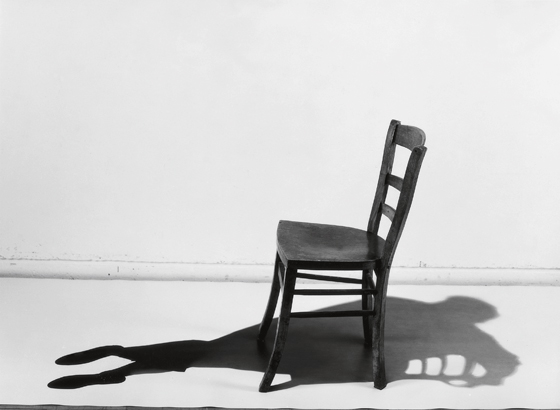
 Floris Neusüss
'Bin Gleich Zurück, (Be Right Back), (Fotogramminstallation), 1984/87'
1984 and 1987
 Floris Neusüss
'Gewitterbild, Kassel, 1984'
Kassel, Germany
1984
 Pierre Cordier
'Chemigram 8/2/61 I, 8 février 1961'
1961
 Pierre Cordier
'Chemigram 20/3/92 "from La Suma of Jorge Luis Borges"
1992
 Pierre Cordier
'Chemigram 20/3/92 "from La Suma of Jorge Luis Borges"
1992
 Susan Derges
'Arch 4 (summer)'
2007/8
 Adam Fuss
'Invocation'
1991
Shadow Catchers: Camera-less Photography
13 October 2010 – 20 February 2011
Victoria and Albert Museum, London
In the 1830s Britain looked on in astonishment as William Henry Fox Talbot successfully drew with light. Talbot’s camera-less photograms, generated by filtering light through solid form onto photographic paper, were praised for being so accurate in tone that they were mistakenly confused for the original object. Almost a century later this method of image production regained popularity with the abstract photograms of Man Ray and László Moholy-Nagy. Working independently from one another, both of these artists were in search of a modernistic photographic essence. Both Ray and Moholy-Nagy were concerned with distancing the photograph from realistic representations of the outside world and would try to offer new perspectives and experiences by removing the camera and its particular way of seeing. This is still the case with more contemporary camera-less photography. Here camera, lens and film no longer work in unison to produce a type of temporal and spatial depiction of reality. Instead there is a simplification of technique; objects are placed between light source and photosensitive paper and then exposed to light. There is a greater level of control in the selection and composition in this type of photographic documentation, making it more akin to drawing than camera-based photography, and therefore in many ways, more adept at communicating an internal reality. Although a seemingly straightforward theme, camera-less photography is in fact an extremely visually prolific and theoretically complex discipline. Exhibitions focussing on this genre of photography run the risk of being bogged down by the technical science of emulsion, photographic chemicals and exposure. On the other hand, camera-less photography is capable of providing a platform to investigate and breakdown in plain terms the perceived indexicality of pre-digital photography.
With these thoughts in mind, I entered ‘Shadow Catchers: Camera-less Photography’. The exhibition presents five artists: Floris Neusüss, Pierre Cordier, Garry Fabian Miller, Susan Derges and Adam Fuss. Each artist’s work is confined to a separate room, the first of which showcases German artist and writer, Neusüss’, full body photograms. The three-dimensionality of these naked figures is implied through the subtle gradations of tone and the manner in which the edges of the figure are slightly fuzzy (the further away the subject is to the photographic paper, the less in focus it will be). These works provide the viewer with a straightforward example of large-format camera-less photography and an engaging and scholastic study of the female form. In Neusüss’ photogram installation, Be Right Back (1984 and 1987), a chair has been placed on top of a large piece of photographic paper capturing the shadow of a seated phantom. This is a playful and savvy comment on the temporality of photography in that photographs record a past presence and therefore present their very own version of death. I found Neusüss’ less figurative work most compelling. His Gewitterbild, Kassel, 1984 (1984) was made through exposing light-sensitive paper during a thunderstorm at night. The turbulent atmosphere of a storm is persuasively echoed in the abstract marks on the photographic paper.
The next room is devoted to the innovative artist, Pierre Cordier (b.1933) and his ‘chemigrams’. On entering Cordier’s area, one is struck by the scientifically experimental nature of his works. He achieves this through exploratory play with photographic chemicals and other materials, such as varnish, wax, glue and eggs. The results are varied, in Chemigram 8/2/61 I, 8 Février 1961 (1961), imbrications of tone and fluidity look like abstract molten mountaintops made from pouring fixative and developer onto lightly oiled photographic paper. Others like Chemigram 20/3/92 ‘from La Suma of Jorge Luis Borges’ look more like acutely intricate labyrinth patterns.
Although Miller’s outcomes are presumably less subject to fortuitous experimentation, he, like Cordier, is obsessed with pushing the boundaries of chemical exploration. Focussing on the materiality of photographic paper he experiments with glass containers filled with coloured liquid. Miller’s coloured circles and squares are meant to represent a space one can inhabit. The spaces in between, where hue emerges and disappears, are meant to signify the transitory nature of being. Having seen Miller speak at The Ingleby Gallery in Edinburgh in 2009, I admittedly found his work far more engaging once I had learnt of his painstakingly precise and monomaniacal process. In Breathing in the Beech Wood, Homeland, Dartmoor, Twenty-four Days of Sunlight, May 2004 (2004) he filters light through beech leaves to demonstrate photosynthesis. Moving from left to right of the photograph, these leaves start with an exposure of one day and increase incrementally up to two weeks. Many of his photographs involve long periods of exposure, some for as long as a year.
Likewise, Derges’ photograms also, strive to reveal hidden forces of nature and convey a sense of the transient, both evolving and dissolving. She is perhaps best known for her photograms of water, created by placing photographic paper in a river at night, which she then exposes with a flashlight. In line with her affinity to nature is her series of arches depicting seasonal scenery. These are produced through a complex mixture of technical procedures, from digital scans to direct prints and then finally, re-photographing. These magical landscapes succeed in portraying the emotion and atmospheric impressions attributed to each season.
The final room is dedicated to the British born artist, Fuss. His dye-destruction photogram, Invocation (1992), is made through floating baby in shallow water over photographic paper and then exposing it with a flashlight. Impressions are left relative to the closeness to the photographic paper. This succeeds in giving the baby a three- dimensional presence and an illusion of an inner spiritual essence. This notion of spirituality is further implied through the title, Invocation. Fuss is more concerned with the inside world than portraying the outside, and his work is rich with symbolism and ideas of the metaphysical. His snakes and ladders and ghosts of reality attempt to deconstruct what it means to be alive and sentient. Indeed, Fuss’s photograms of real elements represent the object as floating in his own mind space, as if part of a dream.
Shadow Catchers offers a palatable introduction to an intriguing and technically complex area of photographic production. It is evident that the artists and their photographs were chosen on the basis of offering thematic variety. However, both the selection of artists and their spatial organisation seem somewhat arbitrary. The screening room, showing short informative films, introduce each artist and their particular method of production. These films provide the only point of intersection, but even this seems a superficial denouement, leaving the viewer with a sense of being shown only the tip of the camera-less photography iceberg. Nevertheless, even though its slight, with its mere five artists and their five rooms, this exhibition does succeed in covering a great deal of ground and leaves one with an blanket sense of what is happening in contemporary camera-less photography.


